
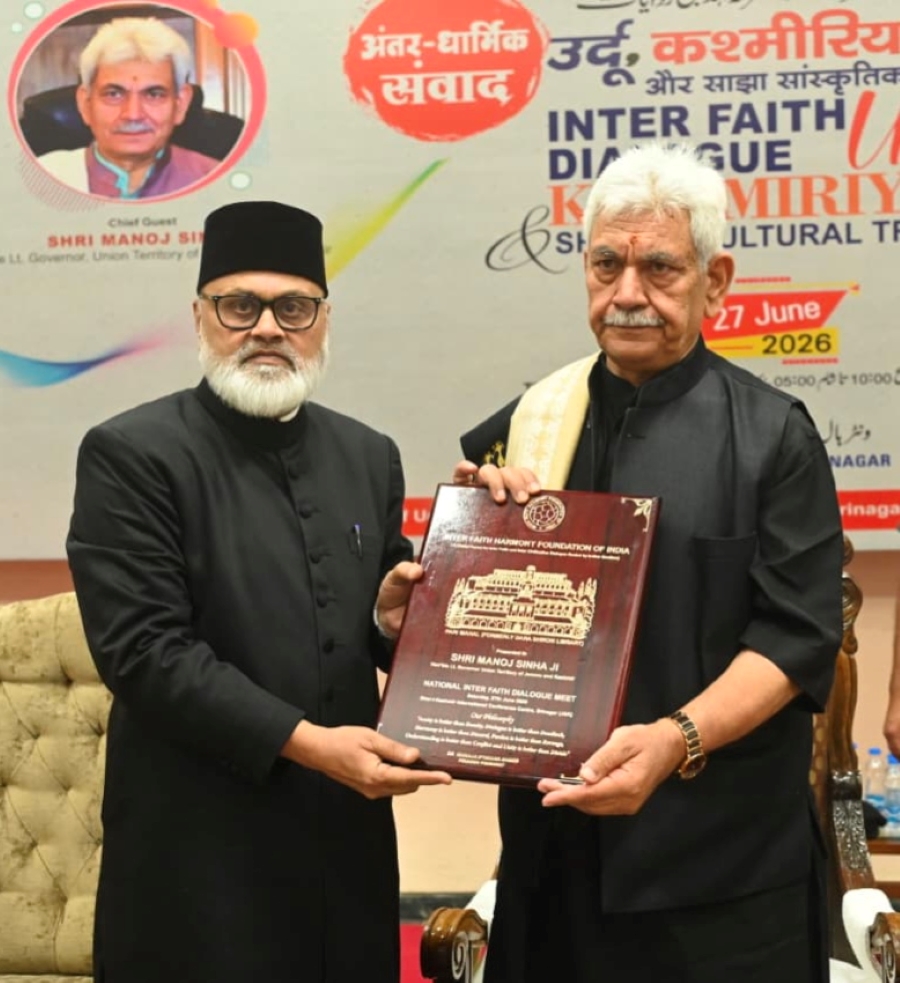
Lieutenant Governor Manoj Sinha highlights India spiritual heritage at interfaith dialogue
SRINAGAR, June 27, 2026Lieutenant Governor Manoj Sinha addressed an interfaith dialogue event in Srinagar today, highlighting India’s legacy as an ancient civilization rooted in mutual respect and peaceful coexistence.
Organized by the National Council for Promotion of Urdu Language and the Inter-Faith Harmony Foundation of India, the event gathered prominent administrative, academic, and literary figures to discuss global unity.
The Lieutenant Governor emphasized that the core spirit of Sanatana Dharma and Indian philosophy offers a guiding light to a world currently facing conflict and intolerance, possessing a unique power to bridge contemporary divides across religion, language, and race.
During his address, the Lieutenant Governor noted that Hinduism, as the world’s oldest living religion, has historically embraced diversity rather than imposing itself, establishing a foundation of respect that allowed Christianity, Islam, Judaism, and Zoroastrianism to flourish in ancient India. He described India as a living idea built on the principle of the world as one family, or Vasudhaiva Kutumbakam.
He urged the younger generation to carry this vision forward to remind the global community that peace remains possible through mutual respect. He defined this shared cultural consciousness as Bhartiyata, or Indianness, which champions equal respect for all religions, the pursuit of truth, and unity in diversity.
Reflecting on regional history, the Lieutenant Governor stated that the concept of Kashmiriyat springs directly from this foundational philosophy of Indianness, symbolizing an age-old sentiment of harmony that has defined life in Jammu and Kashmir for centuries.
He observed that when Sufi saints and Islamic scholars arrived in India during the 12th and 13th centuries, they were inspired by the spiritual traditions of the Vedas, Upanishads, Buddhism, and Jainism, adopting the ideals of coexistence found in Indian scriptures.
He concluded by reiterating that India’s spiritual tradition has never demanded that individuals abandon their faith, but has instead always invited diverse communities to live together in harmony while preserving their distinct traditions.