
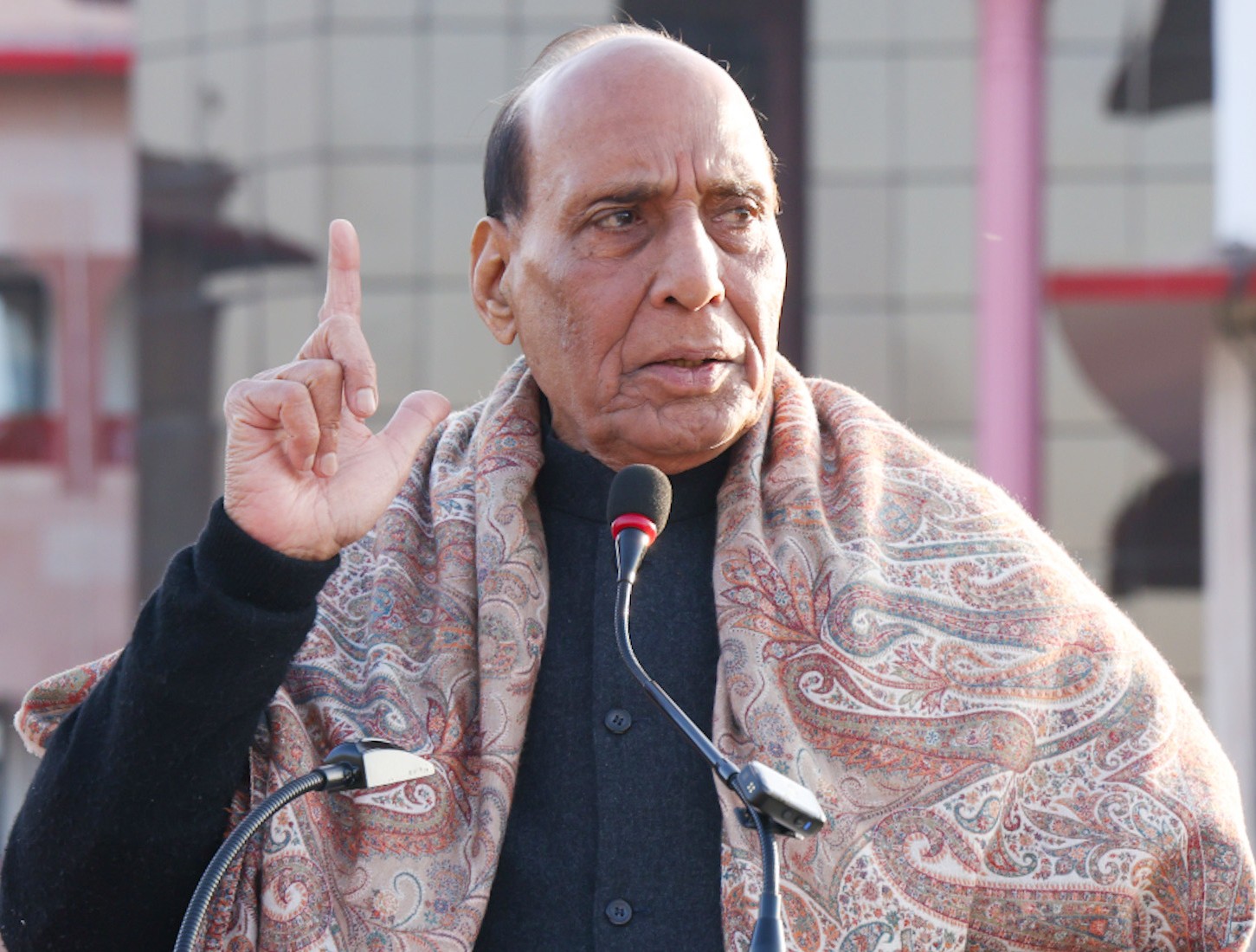
Tomorrow’s battlefield will reward those who shorten time between idea, prototype & operational deployment, says Rajnath Singh
NEW DELHI, MAY 14, 2026 — Defense Minister Rajnath Singh emphasized that achieving self-reliance and operational jointness is essential for India to maintain strategic autonomy and prepare for the battlefields of tomorrow. Addressing the “Kalam & Kavach 3.0” strategic dialogue via video message, Singh noted that the speed of modern warfare will reward those who can most efficiently bridge the gap between an initial idea, a prototype, and full operational deployment. He warned that in an era defined by cyber threats, supply-chain vulnerabilities, and hybrid warfare, national security can no longer rely on outdated assumptions. Instead, the nation’s strength will be determined by how seamlessly defense forces, laboratories, and industries think and act as a unified entity to design and produce critical systems within the domestic ecosystem.
Minister of State for Defense Sanjay Seth further reinforced this vision during his inaugural address, highlighting the “JAI” framework—Jointness, Aatmanirbharta (Self-reliance), and Innovation—as the core of India’s security architecture. Seth pointed to “Operation Sindoor” as a landmark example of the country’s maturing capabilities, showcasing a zero-tolerance approach to terrorism through indigenous technology and seamless inter-service coordination. The government’s focus on domestic manufacturing is yielding record results; defense exports have surged from 686 crore a decade ago to 38,424 crore today, with annual production hitting an all-time high of 1.54 lakh crore in the 2025-26 fiscal year. The administration aims to push these figures to 50,000 crore in exports and 3 lakh crore in production by 2029-30.
The conclave, attended by military leadership, industry experts, and international diplomats, served as a platform to discuss the integration of high-end technologies such as AI-enabled warfare, hypersonic systems, and quantum-enabled C4ISR. Chief of Integrated Defense Staff Air Marshal Ashutosh Dixit reiterated that the ability to create cutting-edge technologies domestically is the only way to secure a strategic future. By fostering a robust ecosystem involving startups, academia, and private industry, India is positioning itself as a global hub for aerospace and security innovation, ensuring that its journey toward a developed nation by 2047 is backed by a technologically advanced and strategically confident military.