
Nitin Nabin rules out Article 370 return, Says Jammu and Kashmir transformed under Modi government
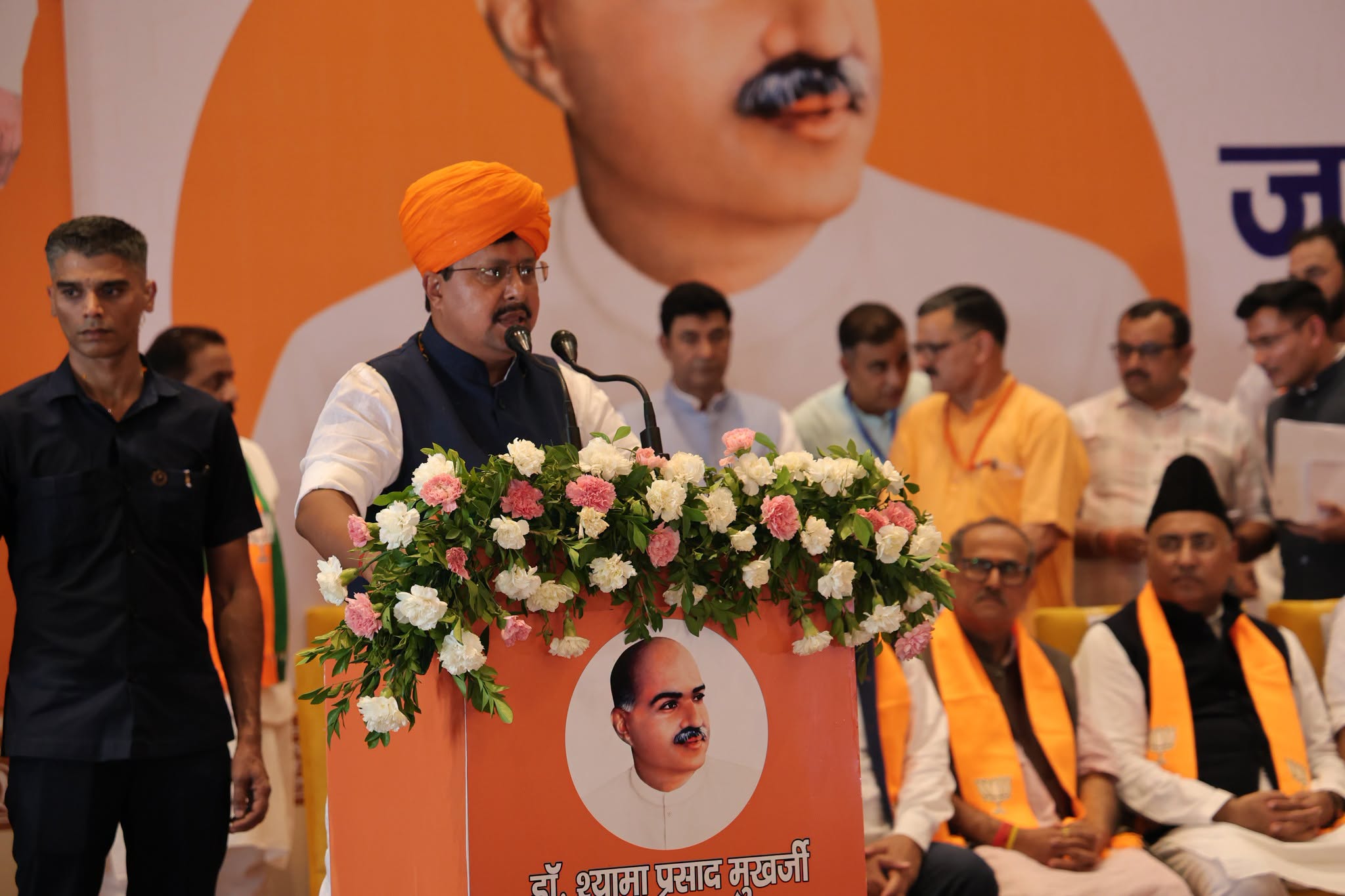
JAMMU, July 6 — Bharatiya Janata Party National President Nitin Nabin delivered a comprehensive address at a major commemorative event organized in Jammu today to mark the one hundred and twenty-fifth birth anniversary of the widely revered nationalist leader Syama Prasad Mookerjee.
Speaking to a massive gathering of party members, local citizens, and regional representatives, Nabin described Mookerjee as an enduring symbol of unyielding nationalism, national unity, and ultimate personal sacrifice for the integrity of the country. The commemorative programme served as a platform for the party leadership to reflect deeply on the historical trajectory of Jammu and Kashmir, assessing the monumental shift from decades of regional isolation to its current alignment with mainstream national growth.
Throughout his extensive speech, Nabin emphasized that the political, social, and economic landscape of the Union Territory has undergone a permanent and positive transformation, directly fulfilling the foundational aspirations that the party has championed since its early days as the Bharatiya Jana Sangh. The event was attended by a large cohort of prominent regional and national political figures, including Jammu and Kashmir state president Sat Sharma, Union Minister Jitendra Singh, national general secretary Tarun Chugh, and the Leader of the Opposition in the Jammu and Kashmir Legislative Assembly Sunil Sharma, alongside numerous senior organizational leaders and grassroots workers.
In his opening remarks, Nabin underscored the profound historical and emotional weight of celebrating the legacy of Mookerjee within the geographic boundaries of Jammu and Kashmir. He stated that the day held exceptional significance for every single member of the organization, functioning as an occasion to honor a leader who served as a guiding force, an intellectual pathfinder, and a visionary for a unified India.
Addressing the thousands of party workers assembled in the venue, Nabin extended his warmest salutations and greetings, taking care to state that every individual within the organization carries equal importance regardless of whether they serve at the highest organizational tiers or operate directly at the grassroots level. He emphasized that the true institutional strength of the party does not emanate from the leaders who occupy public stages, but rather from the highly dedicated volunteers who work tirelessly at the final polling booths and the most localized organizational levels. It is these workers, he noted, who remain completely committed to ensuring that the political philosophy of the organization continues to expand and resonate with the public.
Nabin expressed his admiration for the immense enthusiasm displayed by people across the entire region of Jammu and Kashmir who observed the anniversary in diverse ways, framing the widespread participation as a direct testament to the deep respect the local population holds for Mookerjee, who ultimately sacrificed his life while leading the historical struggle for the complete integration of the region.The core of the address focused extensively on the realization of the foundational slogan formulated by Mookerjee, which demanded an end to the system of dual citizenship, separate constitutions, and distinct regional flags through the doctrine of one nation, one constitution, one leader, and one national flag.
Nabin asserted with absolute clarity that this historic vision, which had remained unfulfilled for over seven decades, was finally translated into reality through the decisive and courageous leadership of Prime Minister Narendra Modi. Reflecting on the long and often perilous journey required to reach this political milestone, Nabin shared personal reminiscences from his own career to illustrate the stark contrast between the past and present administrative climates. He recalled his experiences from fifteen years prior, specifically during the national integration journey undertaken in the year 2011 by the youth wing of the party, the Bharatiya Janata Yuva Morcha.
At that time, Nabin was serving as the national general secretary of the youth wing, working in close coordination with its then national president Anurag Thakur. The leadership of the youth wing had resolved to undertake a massive public procession that would trace a symbolic path beginning directly at the birthplace of Mookerjee in West Bengal and concluding at the specific location in Kashmir where the leader had made his supreme sacrifice for national unity in the year 1953.Nabin described the deep anxiety and political unrest that the 2011 integration journey triggered within the ruling establishments of the era, noting that both the central government in New Delhi and the regional administration in Jammu and Kashmir were profoundly rattled by the movement.
The authorities feared that the public procession would carry an overwhelmingly powerful message of national unity that would destabilize the established political status quo of the region. Recalling the specific logistics of that historical moment, Nabin detailed how he had traveled directly to Kashmir in January 2011 alongside senior organizational secretaries Mahesh and Ganga Prasad to formally inform the local administrative apparatus of their explicit intention to hoist the Indian national flag at the historic Lal Chowk in Srinagar. He emphasized that the current generation of citizens, particularly the youth residing within Jammu and Kashmir, possesses a fundamental right to know about this complex and restrictive chapter of regional history. During his meetings with the local administrative and law enforcement officials at the time, Nabin was explicitly informed by state authorities that any attempt to hoist the Indian Tricolour at Lal Chowk would cause immediate public disorder and permanently disrupt the fragile peace of the valley.
He pointed out the bitter historical irony of that period, noting that while the ruling political coalition in New Delhi and the state capital strictly prohibited the display of the Indian national flag under the pretext of maintaining order, opposing flags were frequently allowed to be displayed openly at the very same location.To further illustrate the intensity of the institutional resistance faced by nationalist workers during that era, Nabin revealed the clandestine and creative methods that volunteers were forced to adopt simply to bring the national flag into the valley. He explained that during the governance of the previous regimes, anyone attempting to carry the Indian Tricolour into Kashmir faced immediate suspicion, and their personal luggage was subjected to rigorous and intrusive security checks at the regional airports under the explicit assumption that transporting the national flag constituted a provocative act. Consequently, party workers had to resort to wrapping the national flags securely inside large bundles of daily newspapers published in Jammu, using the standard distribution channels of the print media to secretly transport the symbols of national identity into the Kashmir valley.
Nabin framed these historical details as a definitive answer to contemporary critics and opposition leaders who frequently question what has substantively changed in the governance and security ecosystem of Jammu and Kashmir. He stated that the truth of a transformed India is visible to anyone who possesses the objective vision to look at reality, pointing out that following the historic legislative decisions of August 2019, when the parliament permanently abolished the special status under Article 370 and Article 35A, the people of the region attained true constitutional freedom, and Lal Chowk became a place where the national flag is displayed permanently, securely, and with immense public pride.The historical narrative presented by Nabin also touched upon earlier organizational milestones, specifically referencing the landmark national unity journey led by the veteran leader Murli Manohar Joshi in the early 1990s.
Nabin reminded the audience that during that highly dangerous undertaking, Narendra Modi had participated actively as a young organizational general secretary and dedicated worker, navigating immense security threats to ensure that the national flag was successfully hoisted in the region. He expressed profound joy that as the country celebrates the one hundred and twenty-fifth birth anniversary of Mookerjee, the political ideas he championed are not only flourishing in Jammu and Kashmir but are also advancing successfully in his home state of West Bengal. Despite facing severe political opposition and being labeled as an external political entity by local adversaries in the east, the organization has established a powerful institutional presence in Kolkata and across West Bengal. The symbol of the lotus has expanded significantly in Mookerjee’s birthplace, setting entirely new benchmarks for regional development, political representation, and the defense of cultural heritage against the forces of regionalism and political appeasement.
Nabin turned his attention to the profound socio-economic shifts affecting the daily lives of the citizens of Jammu and Kashmir, expressing deep gratitude to the local population and the party workers who endured immense personal hardships and physical insecurity during decades of conflict. He asserted that if the central government had not intervened decisively to change the political landscape, the youth of Jammu and Kashmir would have remained trapped in a cycle of institutional neglect, often exploited by separatist elements and labeled in public discourse primarily as stone-pelters. Under the current administrative paradigm, the energy of the youth has been deliberately channeled into constructive, professional, and athletic pursuits. Nabin highlighted the inspiring example of local athletes emerging as competitive champions in the Ranji Trophy and representing the nation on global platforms, framing these sports achievements as the defining symbol of a modern, forward-moving India.
He emphasized that the prime minister has deliberately promoted sports infrastructure not merely as a tool for physical entertainment, but as a core strategic pillar for fostering sustainable peace, social harmony, and professional excellence across the towns and villages of the territory.The speech provided a detailed historical and biographical exploration of Mookerjee’s life to serve as an intellectual blueprint for the younger generation. Nabin detailed how Mookerjee excelled as an extraordinary academician, achieving the historic distinction of becoming the Vice-Chancellor of Calcutta University at the exceptionally young age of thirty-three. During his academic tenure in the year 1937, Mookerjee demonstrated profound cultural foresight by facilitating a historic milestone where the Nobel laureate Rabindranath Tagore addressed the university convocation entirely in the Bengali language rather than English, marking a seminal victory for the preservation of regional languages and native cultural identity.
Furthermore, when India achieved independence and Mookerjee was selected to serve as the nation’s very first Minister for Industry and Supply, he laid down the structural foundations of the country’s modern industrial economy. Nabin noted that it was under Mookerjee’s direct executive vision and initiative that India established its most critical post-independence industrial pillars, including the Chittaranjan Locomotive Factory, the Sindri Fertilizer Plant, and the Hindustan Aircraft Factory. Even in the late 1940s and early 1950s, Mookerjee strongly advocated for a balanced model of governance where rapid industrialization and technological progress went hand in hand with the deep preservation of national heritage, domestic manufacturing capabilities, and traditional cultural values.Nabin directly linked this early post-independence industrial philosophy with the current economic strategies implemented by the central government, specifically the global manufacturing initiative known as Make in India. He argued that the contemporary push for complete domestic self-reliance, advanced manufacturing setups, and robust local supply chains was originally envisioned in Mookerjee’s seminal industrial policy statements of the year 1948.
This overarching vision of national strength has yielded unprecedented economic results on a macro scale, with Nabin citing official data showing that over two hundred and fifty million individuals nationwide have been successfully lifted out of multi-dimensional poverty over the past decade. He emphasized that countless vulnerable families residing within the borders of Jammu and Kashmir have been direct beneficiaries of these comprehensive poverty alleviation measures, receiving structural economic support, advanced healthcare access, and modern housing facilities that were completely unavailable to them under previous regional administrations.A substantial portion of the address was dedicated to analyzing the severe developmental stagnation that characterized Jammu and Kashmir during the decades when Article 370 was operational. Nabin argued that the special constitutional provision did not protect the local population as its defenders claimed, but instead created an insulated, non-transparent governance system that systematically deprived ordinary citizens of basic developmental rights while concentrating political and economic power within a small circle of regional political dynasties.
This legal isolation prevented the effective implementation of progressive central laws, hindered external capital investment, restricted industrial job creation, and left the local economy entirely dependent on limited central subsidies. Following the permanent deactivation of these restrictive articles, the central government has succeeded in establishing entirely new benchmarks of infrastructure development and public welfare, positioning Jammu and Kashmir as a leading region in terms of modern public administration, connectivity projects, and socio-economic growth.Nabin placed special emphasis on the current administration’s comprehensive shift in defining the target demographics of public welfare policy. He stated that the prime minister has fundamentally discarded the older political rhetoric that divided the population along sectarian or caste lines for electoral gain, choosing instead to focus government resources entirely on the empowerment of four universal pillars of society: the poor, the youth, the farmers, and women.
The execution of public welfare initiatives under this framework has reached unprecedented historical proportions, characterized by the deployment of advanced technology to ensure absolute transparency. Nabin highlighted the success of the Direct Benefit Transfer mechanism, noting that the central government has successfully transferred more than ninety-one lakh crore rupees directly into the verified bank accounts of individual beneficiaries across the country. This systemic reform has completely bypassed traditional middle-tier bureaucracies and political intermediaries, ensuring that every single rupee allocated by the central treasury in New Delhi reaches the intended impoverished recipient in full, effectively eliminating the systemic corruption that historically drained development funds within the region.The party president detailed several specific central welfare initiatives that have brought transformative structural changes to rural households in Jammu and Kashmir, including the ambitious program to train and empower three crore rural women to become high-earning entrepreneurs, a movement colloquially known as Lakhpati Didis. This program is running in close tandem with the universal health insurance coverage provided under the Ayushman Bharat scheme and the extensive construction of permanent brick-and-mortar housing for low-income families under the Pradhan Mantri Awas Yojana. Nabin noted that these combined initiatives ensure that the fundamental rights of health, shelter, and financial security are delivered directly to the most isolated citizens, transforming the abstract concept of national development into a tangible daily reality for the marginalized population.
The strategic geopolitical outlook of the central government also formed a major theme of the Jammu address, with Nabin explaining a profound shift in how the nation views its border regions. He contrasted the traditional bureaucratic mindset of previous administrations, which routinely classified remote frontier settlements as the neglected last villages of the nation, with the modern doctrine implemented by the current prime minister. Today, these border communities are officially recognized as the first villages of India, and their comprehensive security, economic development, and digital integration are treated as the foremost responsibility of the national defense and administrative apparatus. This philosophical pivot has provided immense psychological and structural strength to the populations living along the international borders and lines of control in Jammu and Kashmir, reassuring them that their daily welfare and safety are monitored directly by the highest levels of governance in the national capital.To provide empirical context to this claims of rapid modernization, Nabin presented a series of comparative infrastructural metrics detailing the scale of physical development achieved nationwide and regionally. He pointed out that the total length of operational national highways across the country has expanded from approximately ninety-one thousand kilometers a decade ago to nearly one hundred and fifty thousand kilometers today, significantly improving connectivity to previously inaccessible mountain terrains. Similarly, the total number of operational commercial airports has more than doubled, increasing from seventy-four to one hundred and sixty, thereby facilitating record levels of regional accessibility and tourism.
On the industrial front, India has rapidly ascended to the second-largest position globally in terms of mobile phone and telecommunications manufacturing. Nabin argued that this data demonstrates a fundamental transformation where India has ceased to be viewed by global markets merely as a source of cheap manual labor or human resources, emerging instead as a highly sophisticated, self-reliant global hub of manufacturing and industrial power.Addressing the internal political dynamics of the Union Territory, Nabin issued a stern warning against the political platforms of contemporary regional opposition parties, accusing them of maintaining institutional double standards and continuing to exploit sectarian sentiments. He reiterated that the Bharatiya Janata Party operates under the strict guiding principle that development and public welfare must never be viewed through the narrow lens of religion or regional identity.
The party maintains that every single impoverished individual, regardless of their background, is an equal citizen of India, and it remains the non-negotiable duty of the state apparatus to ensure their holistic development and security. Nabin cited the historic legislative abolition of the practice of triple talaq as a prime example of this commitment, explaining that the objective of the reform was to provide long-overdue legal protection, self-reliance, and basic human dignity to Muslim women who had been left legally vulnerable for decades by previous regimes under the guise of protecting personal laws.Looking forward to the long-term political strategy of the organization, Nabin mapped out a intensive twenty-year horizon of sustained grassroots mobilization leading up to the centenary of Indian independence in the year 2047. He informed the assembled party workers that the period ahead would require unwavering dedication, deep personal struggle, and a continuous, direct dialogue with ordinary citizens in every neighborhood and village. He emphasized that a fully developed nation, or Viksit Bharat, cannot be achieved without building a thoroughly developed and economically vibrant Jammu and Kashmir. Nabin expressed absolute institutional confidence that through the continuous hard work of its volunteers, the organization would see its political presence expand dramatically across both the Jammu province and the Kashmir valley, ultimately leading to the democratic formation of a dedicated majority government in the Union Territory.The speech concluded with a comprehensive overview of the regional security paradigm, where Nabin delivered a direct and uncompromising message regarding cross-border terrorism and internal subversion. He recalled a recent period where external state-sponsored actors and militant groups attempted to destabilize the region by executing targeted attacks designed to disrupt public safety and strike fear into local communities.
In response to these provocations, the central government demonstrated that the modern Indian state operates on entirely new parameters of military capability and defensive resolve. Nabin specifically highlighted the execution of Operation Sindoor as a decisive, sophisticated, and crushing security response that successfully neutralized hostile threats and clearly demonstrated to external adversaries the strict boundaries of national patience. He stated that the modern administration will always provide a swift, overwhelming, and befitting reply to any entity that dares to threaten the security of the nation, the dignity of its citizens, or the territorial integrity of Jammu and Kashmir.Reaffirming the definitive legal and political position of the national leadership, Nabin invoked recent statements made by Union Home Minister Amit Shah, confirming that Jammu and Kashmir is an unalterable, inseparable, and permanent integral part of the Indian Union. He dismissed recent public pronouncements made by opposition figures regarding the potential revival of regional special status, declaring with absolute finality that Article 370 has been permanently dismantled and that no political force can ever succeed in resurrecting it. The stabilization of the security environment has already yielded historic economic benefits, most notably a massive and unprecedented boom in the local tourism sector. Millions of domestic and international travelers are currently visiting the valleys, high-altitude resorts, and cultural heritage sites of Jammu and Kashmir without fear, revitalizing the local hospitality industry, generating robust employment avenues for the youth, and cementing a sustainable ecosystem of peace and economic prosperity.
Nabin concluded by calling upon all party members to pledge themselves anew to the foundational values of national integration, effective public governance, and the socio-economic upliftment of the final individual, ensuring that the historical sacrifices of the party’s founders culminate in a prosperous and fully integrated future for the entire region.