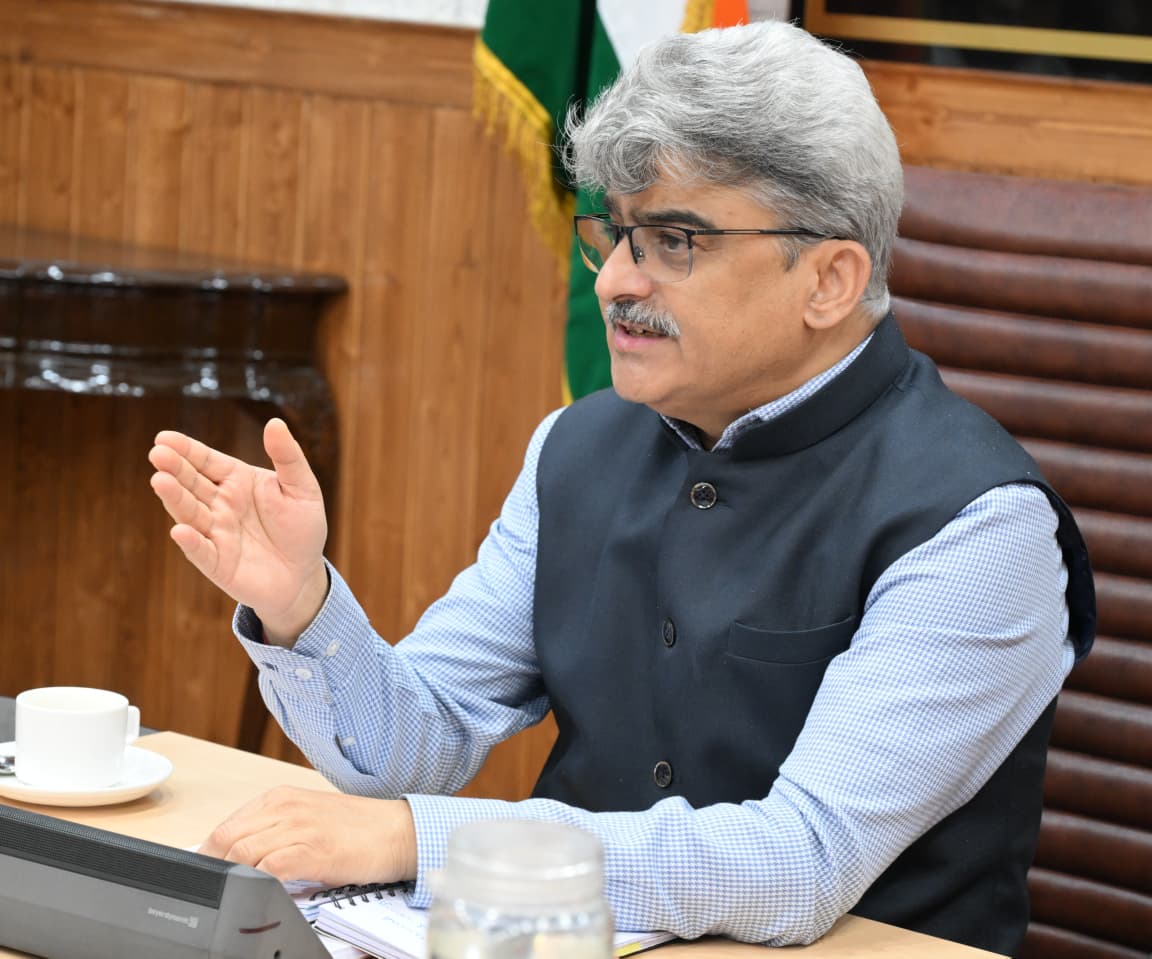
SRINAGAR, May 21, 2026 — Chief Secretary Atal Dulloo chaired the 27th Steering Committee meeting of the Jammu and Kashmir Compensatory Afforestation Fund Management and Planning Authority today to evaluate ecological restoration achievements across the Union Territory.
Emphasizing the need for institutional accountability and the sustainable restoration of degraded landscapes, the Chief Secretary directed the Forest Department to digitize all forest maps and boundary pillars to secure effective land demarcation.
In a major policy shift to boost efficiency, he ordered that future contractor payments be strictly linked to the actual survival rate of the planted material, instructing the Finance Department to review future tenders to incorporate these accountability clauses.
He also mandated an increased field presence of forest officials up to the rank of Rangers to monitor vulnerable green spaces directly.
The committee reviewed extensive data detailing the progress of the green initiative since its inception in 2010. Presentations revealed that over 1.06 lakh hectares of degraded forest area have been treated through assisted natural regeneration and ecological restoration measures, with nearly 746.65 lakh saplings planted across various divisions.
Officials noted that forest land diversion for non-forestry purposes has sharply declined after 2020, while the annual area treated under afforestation programs has nearly doubled.
During the financial year 2025-26 alone, the department successfully treated 2,952 hectares, completed 12.65 lakh running feet of protective fencing, raised 68.70 lakh saplings in nurseries, and executed 37,001 cubic meters of soil and moisture conservation works.
The session also highlighted extensive infrastructure development and specialized conservation projects funded under the initiative. Key interventions include soil stabilization and moisture conservation via dry rubble stone masonry and water harvesting structures, alongside dedicated catchment area treatment for major hydroelectric ventures like the Pakal Dul, Kiru, Kwar, Ratle, and Shahpur Kandi projects. Furthermore, the fund has strengthened wildlife conservation facilities—specifically within the Kishtwar High Altitude National Park—and built dozens of range offices, check posts, and guard huts to empower frontline staff.
While independent third-party evaluations for recent works recorded an overall plantation survival rate of over 51 percent, the Chief Secretary concluded the meet by demanding stricter scientific monitoring, geo-tagging, and greater community integration to ensure long-term environmental resilience.