
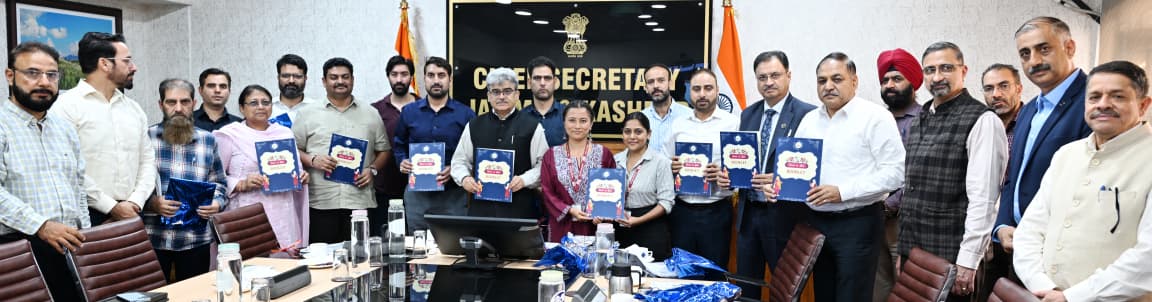
J&K Chief Secretary Directs Strengthening of Women-Led Institutions for Rural Transformation
SRINAGAR, AUGUST 06, 2026 — In a major push toward rural economic transformation, Jammu and Kashmir Chief Secretary Atal Dulloo chaired a comprehensive review meeting of the Jammu and Kashmir Rural Livelihoods Mission (JKRLM). He called for strengthening women-led community institutions through structured capacity building, institutional reforms, and deeper convergence with major government initiatives. Highlighting the pivotal role of women in sustainable development, the Chief Secretary instructed officials to align JKRLM with flagship programs such as Mission YUVA and the Holistic Agriculture Development Programme (HADP). This strategy aims to integrate nearly six lakh Self-Help Group (SHG) members into self-employment, entrepreneurship, and skill development pathways tailored to their aptitudes.
Central to the Chief Secretary’s directive is the operationalization of Community Managed Training Centres (CMTCs) across all 20 districts of the Union Territory. Designed to function as vibrant hubs for social mobilization, these CMTCs will train and sensitize women to actively address social issues including sanitation, nutrition, school enrollment, immunization, and drug abuse prevention. To ensure sustained institutional growth, Dulloo instructed the creation of a dedicated pool of master trainers to cascade block-level instruction to SHG members. Furthermore, he mandated expanding women-led food outlets in partnership with the Kudumbashree National Resource Organisation, simplifying bookkeeping via digital modules, scaling up bank credit linkage for community enterprises, and commissioning an independent qualitative assessment by a national institution to address structural gaps.
The meeting showcased JKRLM’s substantial achievements in empowering rural communities across 285 blocks and 4,291 Gram Panchayats. Presenting the progress report, RDD Secretary Aijaz Asad and JKRLM Managing Director Dr. Shubhra Sharma revealed that the Mission has mobilized over 8.14 lakh women into 96,595 SHGs, 7,546 Village Level Organisations (VLOs), and 652 Cluster Level Federations (CLFs). Financially, the Mission has extended ₹532 crore in capitalization support and facilitated cumulative bank credit exceeding ₹3,449 crore across 1.46 lakh credit-linked accounts. Demonstrating exceptional financial discipline, the Non-Performing Asset (NPA) rate stands at a remarkably low 0.91%.
On the ground, JKRLM continues to drive extensive livelihood and enterprise programs across the region. The Mission supports over 7.35 lakh Mahila Kisans across 5,255 villages through thousands of specialized Community Resource Persons, alongside digitizing training via the Daksh Kisan Portal where over 64,000 farmers are enrolled. Under the Start-up Village Entrepreneurship Programme (SVEP), 11,879 enterprises have been established, supported by ₹21.77 crore in bank credit and ₹20.26 crore from the Community Enterprise Fund. Notably, under the Lakhpati Didi Initiative, 2.40 lakh rural women have attained Lakhpati status, with a phased roadmap set to scale this figure to 3.64 lakh by 2029. Moving forward, JKRLM plans to set up regional marketing aggregation centers in Srinagar and Jammu, formally register CLFs as independent legal entities, and forge deeper links with Panchayati Raj Institutions to secure long-term, inclusive rural prosperity.