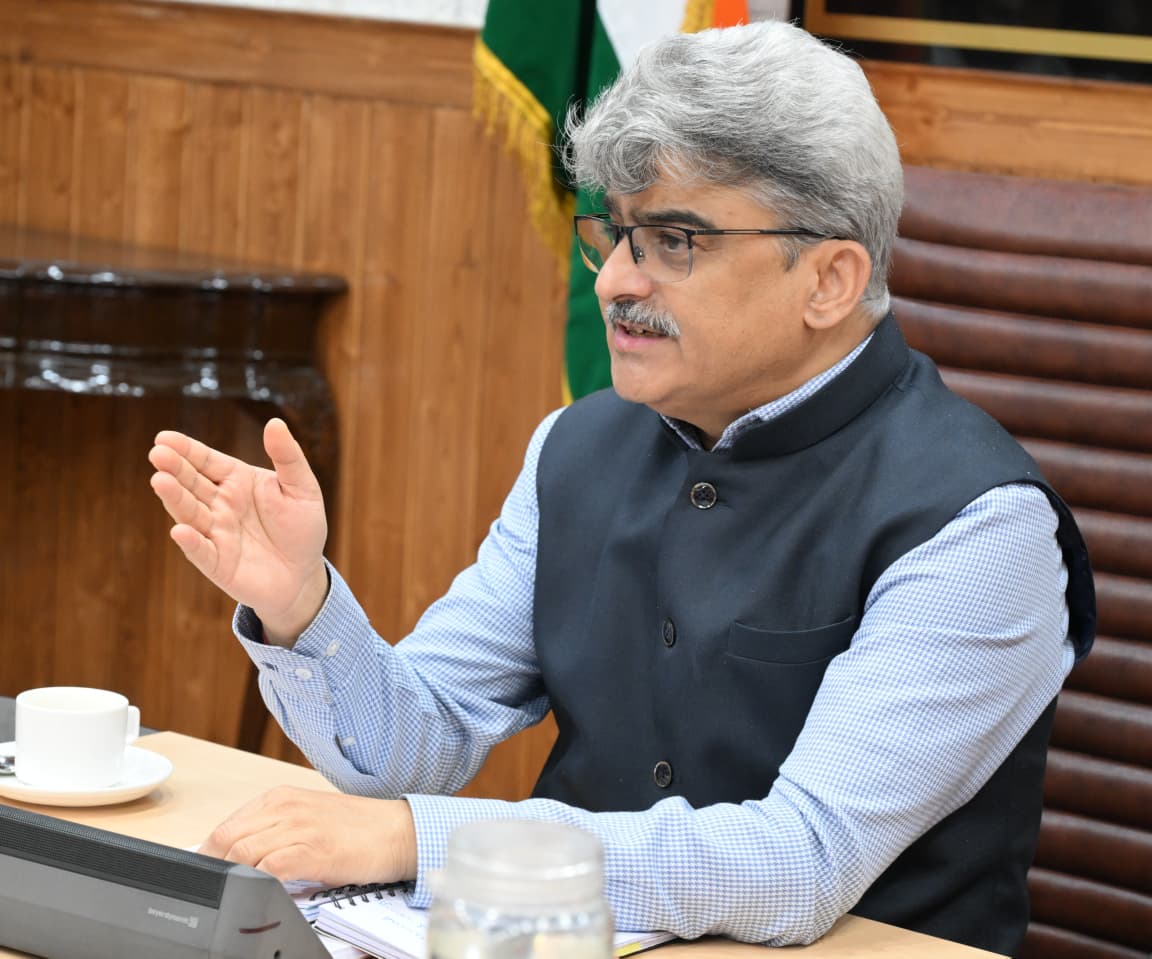
JAMMU, May 20, 2026: Chief Secretary Atal Dulloo reviewed the readiness, operational framework, and future sustainability plan for the Industrial Biotech Parks being established at Kathua and Handwara in Jammu and Kashmir. During the meeting, he stressed the need to transform these facilities into vibrant centers of innovation, entrepreneurship, and technology-driven industrial development.
The high-level review was attended by various administrative secretaries, heads of scientific institutions, university faculty members, and senior officials, including Commissioner Secretary of the Science and Technology Department Babila Rakwal, Director of CSIR-Indian Institute of Integrative Medicine Dr Zabeer Ahmed, and CEO of the Centre for Innovation and Transformation in Governance Dr Sandeep Ananthanarayanan.
During the session, the Chief Secretary assessed the completed infrastructure at the Ghatti facility in Kathua and evaluated the steady progress of the Handwara project. He directed the Science and Technology Department to address existing governance gaps by utilizing the established society framework and implementing a professional management system for daily operations.
He also emphasized clearly defining the collaborative roles of the department and CSIR-IIIM Jammu to foster a supportive ecosystem for startups, capacity building, and technical mentoring. To ensure tangible outcomes, the Chief Secretary called for the formulation of measurable Key Performance Indicators with defined timelines, aiming to elevate these parks into premier national innovation assets.
Babila Rakwal provided an overview of the current infrastructural status, noting that efficient functioning requires professional management guided by IIIM Jammu, adequate departmental funding, and convergence with central government schemes.
Detailed presentations by Dr Zabeer Ahmed and Dr Sandeep Ananthanarayanan highlighted the operational roadmap, including a three-bucket strategy designed for long-term economic viability and self-sufficiency through public-private partnerships.
The 10-acre Kathua facility already features advanced infrastructure like fermentation units, micro-propagation labs, and a BIRAC-BioNEST Incubator supporting agri-based startups, nutraceuticals, and healthcare biotechnology.
Both facilities are envisioned as crucial engines for industrial growth, employment generation, and skill enhancement for youth and farmers across the region.