
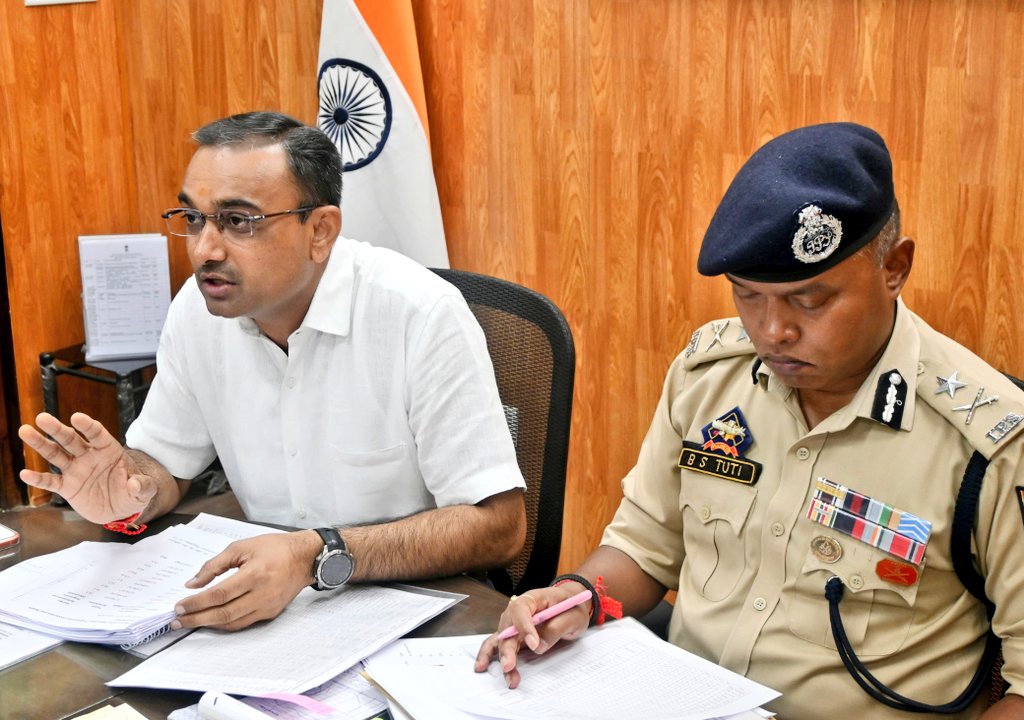
Divisional Commissioner and IGP Jammu review two-month progress of Nasha Mukt Jammu Kashmir Abhiyan
JAMMU, June 15: Divisional Commissioner Ramesh Kumar and Inspector General of Police Jammu Zone Bhim Sen Tuti chaired a high-level meeting to review the two-month progress of the ongoing 100-day campaign under the Nasha Mukt Jammu Kashmir Abhiyan.
The meeting highlighted that the anti-drug drive has transformed into a mass movement across the Jammu Division, recording the execution of 1,32,232 tehsil-level, 1,69,026 panchayat-level, and over 38 lakh village-level awareness programs. To bolster community participation, the administration formed 4,779 Panchayat Mahila Samitis and activated 947 youth clubs, engaging religious and local leaders to generate widespread public support and increase helpline outreach for counseling requests.
Alongside public awareness, strict law enforcement measures were implemented to dismantle regional narco-networks, leading to the identification of 155 drug hotspots. Authorities registered 598 FIRs and arrested 701 drug peddlers, while executing 24 PIT-NDPS detention orders against notorious smugglers. Massive quantities of narcotics, including over 14 kg of heroin, 49 kg of ganja, 3.712 kg of charas, and 204.5 kg of poppy straw were seized, alongside the destruction of illicit crops and illegal liquor.
As a stern deterrent, the administration demolished 62 immovable properties of drug peddlers valued at ₹19.30 crore, attached properties worth ₹24.868 crore, and seized movable assets worth ₹1.69 crore. Additionally, recommendations were made for the suspension of 180 passports, while the Transport Department suspended or cancelled hundreds of driving licenses and vehicle registration certificates.
The review also focused heavily on the rehabilitation of substance abuse victims, identifying 884 youth for rehabilitation out of 2,293 registered drug users. To date, 547 youth have been successfully rehabilitated, with 254 linked directly to self-employment schemes.
Divisional Commissioner Ramesh Kumar emphasized the need to strengthen the regional rehabilitation ecosystem, expand counseling facilities, and frequently publicize tele-assistance helpline numbers. He directed district administrations to provide sports kits to children, regularly monitor emerging hotspots, ensure strict data-driven management, and order the Drug Controller to conduct rigorous inspections of chemist shops to curb the illegal sale of regulated formulations.
Concluding the session, IGP Bhim Sen Tuti commended the substantial progress achieved so far and urged all district heads to conduct mandatory, regular NCORD meetings to completely eradicate drug abuse from society.