
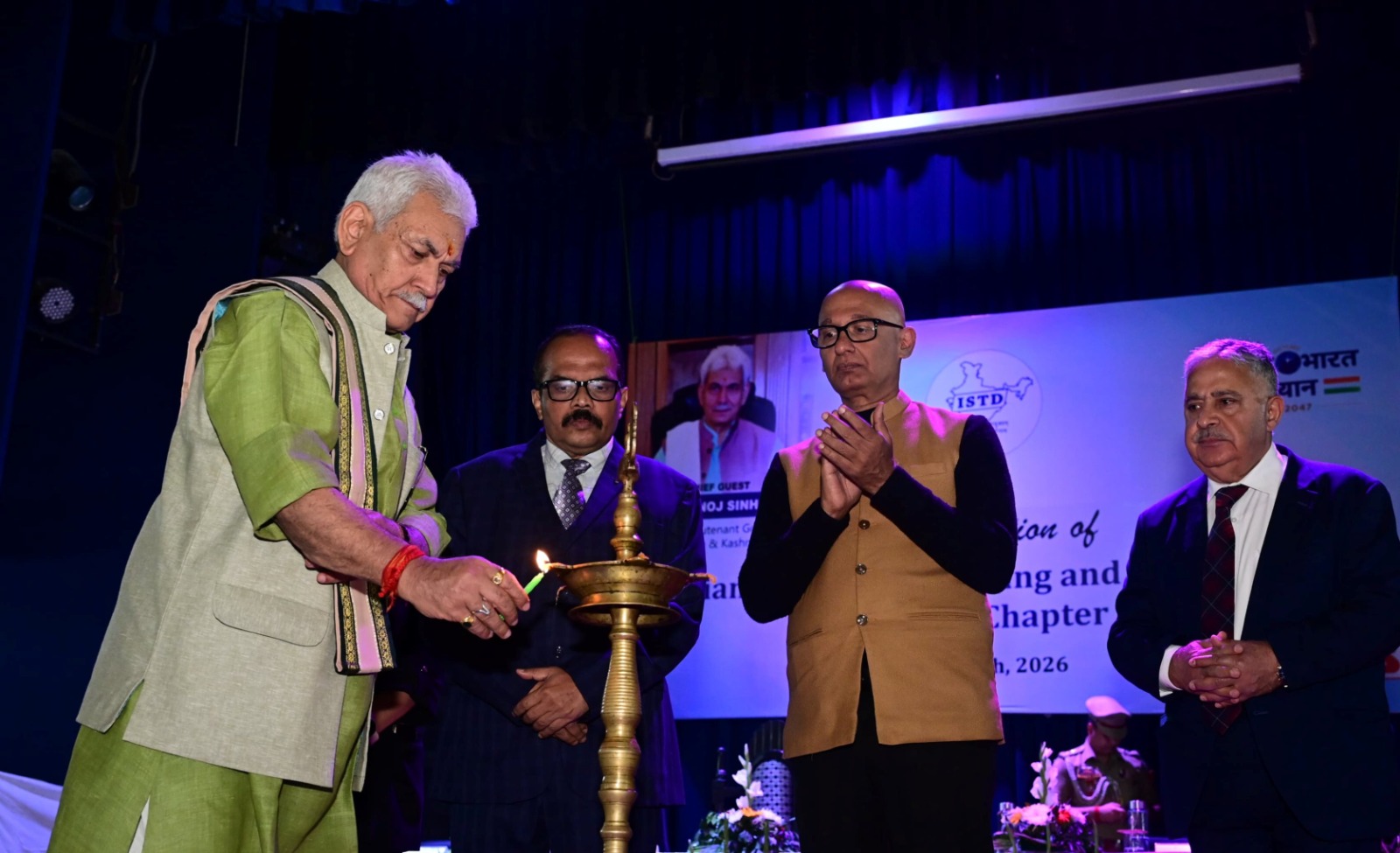
Lieutenant Governor Launches ISTD Jammu Chapter to Drive Skill Development and Global Competitiveness
JAMMU March 25, 2026:-Lieutenant Governor Manoj Sinha officially inaugurated the Jammu Chapter of the Indian Society for Training & Development (ISTD) today at Padma Sachdev Government PG College for Women, Gandhinagar.
Addressing a large gathering of educators, professionals, and students, the Lieutenant Governor highlighted that this new chapter will serve as a cornerstone in strengthening the region’s learning and development ecosystem.
He envisioned Jammu evolving into a regional hub for professional excellence, tasking the organization with a specific focus on job creation, entrepreneurship, and making local talent globally competitive.
The event was attended by high-ranking officials including ISTD National President Atul Shah, Cluster University Vice Chancellor K.S. Chandrasekar, and ISTD Jammu Chapter Chairman Ashok Aima.
During his keynote address, the Lieutenant Governor emphasized that the modern world’s complex challenges require collective effort and multi-dimensional solutions rather than isolated actions.
He called for a robust collaboration between universities, industries, and the ISTD to foster an environment built on networking, international exposure, and joint training programs.
According to the Lieutenant Governor, the purpose of modern education must shift from merely imparting knowledge to preparing students for life’s practical hurdles through a focus on soft skills, research, and a thriving startup culture.
He urged stakeholders to empower individuals to confront emerging challenges head-on to realize the national vision of a developed India.The Lieutenant Governor further detailed the need for targeted interventions in key sectors such as agriculture and industry.
He stressed that Jammu Kashmir’s industrial landscape must continuously invest in new skills to maintain productivity amid a changing global ecosystem. For the agricultural sector, he advocated for training farmers in modern technology, resource management, and scientific methods to combat climate change and water crises while improving market linkages.
Concluding his remarks, he noted that while technology and capital are important, the most powerful instrument of change remains a trained and awakened professional mind, which serves as the true engine for inclusive growth and future progress.