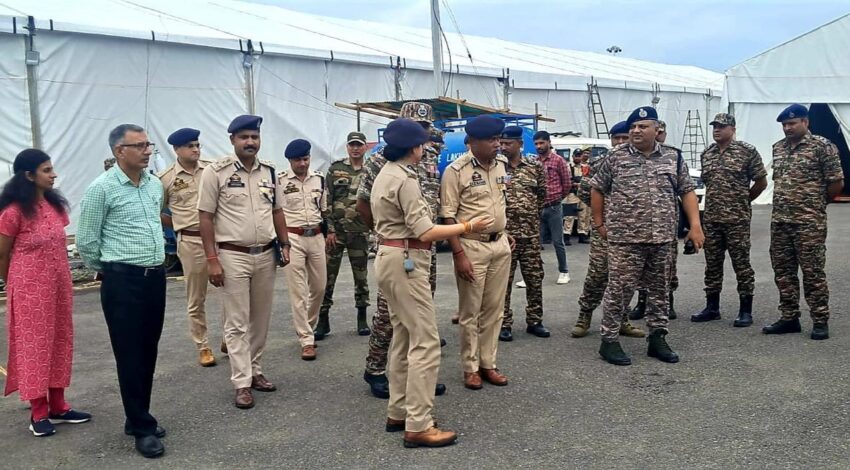
JAMMU, JULY 12, 2026 — In a comprehensive move to fortify the security apparatus for the ongoing Shri Amarnath Ji Yatra (SANJY) 2026, Inspector General of Police (Jammu Zone) Bhim Sen Tuti and Inspector General of CRPF (Jammu Sector) Amol V. Homkar led a high-level strategic review across the border and highway districts of Samba and Kathua today. Accompanied by Deputy Inspector General of Police (JSK Range) Shridhar Patil and Deputy Inspector General of CRPF Awadhesh Pathak, the senior command assessed the operational readiness, inter-agency synergy, and anti-sabotage frameworks established to safeguard thousands of arriving pilgrims. The joint inspection focused heavily on eliminating gaps in the security blanket along the critical National Highway corridor, ensuring rapid emergency response capabilities, and maximizing multi-agency coordination during this sensitive pilgrimage window.
Beginning the multi-stage security audit at Lakhanpur, the entry gateway to Jammu and Kashmir, Jammu Zone Police Chief Bhim Sen Tuti personally inspected the pilgrim reception infrastructure, evaluation frameworks, and round-the-clock frisking checkpoints. Following the field inspection, a targeted security meeting was convened with key administrative and security leaders, including the Deputy Commissioner and Senior Superintendent of Police for Kathua, alongside commanding officers from the 121 Battalion CRPF and 159 Battalion BSF. The leadership evaluated existing vehicle screening, anti-sabotage parameters, and traffic management systems along the highway. Field commanders and zonal officers were instructed to enforce absolute vigilance and maintain uninterrupted 24/7 surveillance while ensuring that security personnel extend maximal logistical support and assistance to the transiting yatris.
Earlier in the day, the security focus shifted to the District Police Office in Samba, where Bhim Sen Tuti and Amol V. Homkar jointly spearheaded an expansive planning session. Senior Superintendent of Police Samba Anuj Kumar presented a granular operational briefing detailing the district’s deployment architecture. The security layout spans the vulnerable lateral entry points, border protection grids, communal kitchens (langars), pilgrim transit accommodation facilities, and the rapid deployment patterns of Quick Reaction Teams (QRTs). In light of recent intelligence inputs, the top commanders scrutinized area domination tactics and convoy escort protocols, mandating that all field units preserve an elite state of tactical readiness to neutralize any emerging threats.
Concluding the strategic assessment, the top leadership underscored that flawless synchronization between the Jammu and Kashmir Police, Central Armed Police Forces (CAPFs), and intelligence networks is non-negotiable for a incident-free Yatra. Bhim Sen Tuti emphasized the need for real-time information sharing and dynamic field positioning, instructing senior staff to conduct regular briefings for ground-level personnel. Concurrently, CRPF Sector Chief Amol V. Homkar demanded rigorous, hands-on supervision of the established security layers, directing senior district police and CAPF officers to execute surprise joint inspections of active deployments to ensure unyielding compliance with standard operating procedures.