
The Serpent’s Sanctuary: The Epic Legacy of Sheshnag and the Sacred Waters of Mansar Lake
UDHAMPUR, Jan 2, 2026 — In the heart of the Shivalik foothills, where the air carries the scent of ancient pines and the stillness of the mountains, lies a site that has fascinated theologians, historians, and travelers for millennia.
Mansar Lake, often hailed as the “Mansarovar of the Duggar region,” is more than a scenic retreat; it is a profound mythological landscape where the physical and the metaphysical worlds collide. At the center of this sacred geography stands the Pracheen Sheshnag Temple, a shrine that guards the secrets of an era 5,000 years past—the age of the Mahabharata.
The Divine Architect: The Legend of Babru Vahan and Sheshnag
The story of Mansar begins with a tragedy born of heroic pride.
Following the catastrophic war at Kurukshetra, the Pandava prince Arjuna performed the Ashwamegh Yagya (Horse Sacrifice) to solidify his sovereign claim over the lands. As the sacrificial horse roamed, it entered the territory of Babru Vahan, the ruler of what is now the Jammu region. Unknown to both, Babru Vahan was the son of Arjuna and the Naga princess Ulpi.
When Babru Vahan captured the horse, Arjuna challenged him, and in a fierce duel near the village of ‘Khoon,’ the son struck down the father. It was only when Babru Vahan presented the severed head to his mother that the horrifying truth was revealed. Driven by remorse, he sought a way to restore Arjuna’s life. The only remedy was the Naga Mani—a divine serpent jewel possessed by Sheshnag, the King of Serpents, who resided in the subterranean realm of Patal Lok.
Using his prowess in archery, Babru Vahan shot a powerful arrow into the earth, creating a massive tunnel that today is identified as Surinsar Lake (formerly Surangsar). He traveled through the depths of the earth, defeated the serpent legions, and emerged with the life-giving jewel at a spot several miles away—the exit point that formed Mansar Lake (formerly Manisar).
The Seat of the Serpent: The Pracheen Sheshnag Temple
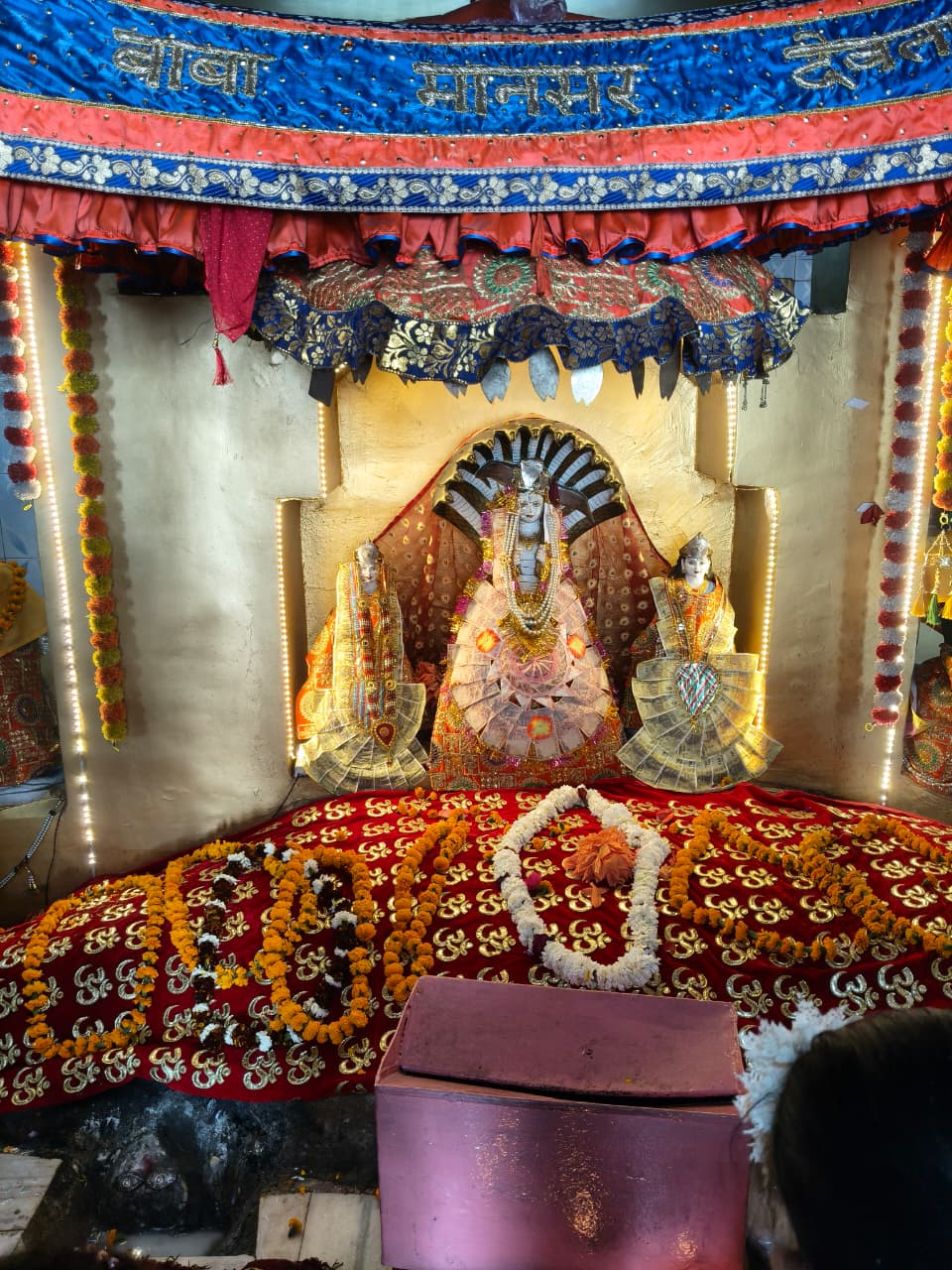
On the eastern bank of Mansar Lake stands the primary spiritual sentinel of the region: the Sheshnag Temple. Unlike the ornate marble structures of modern cities, this shrine exudes an aura of primal power. The main sanctum sanctorum houses a majestic black stone idol of the six-headed serpent god, adorned with silver ornaments and a crown that glimmers in the flickering light of oil lamps.
What makes this temple unique is its architecture of devotion. Surrounding the central deity are ancient iron chains draped over large boulders—symbolic representations of the smaller serpents that wait upon the King of Nagas. Devotees believe that Sheshnag does not merely reside in the stone idol but dwells within the very depths of the lake itself. Local legend whispers that the serpent king occasionally manifests in the form of a giant turtle, guarding the waters that were born from the arrow of a Pandava prince.
Rituals of Redemption: Newlyweds and the ‘Mundan’ Tradition
The Sheshnag Temple is the heartbeat of the local community’s social and religious lifecycle. It is an unshakeable tradition for newlyweds in the Jammu region to visit the shrine to seek the Lord’s protection. Couples perform three Parikramas (circumambulations) around the entire 1.6-kilometer perimeter of the lake, a ritual believed to grant eternal harmony and fertility.
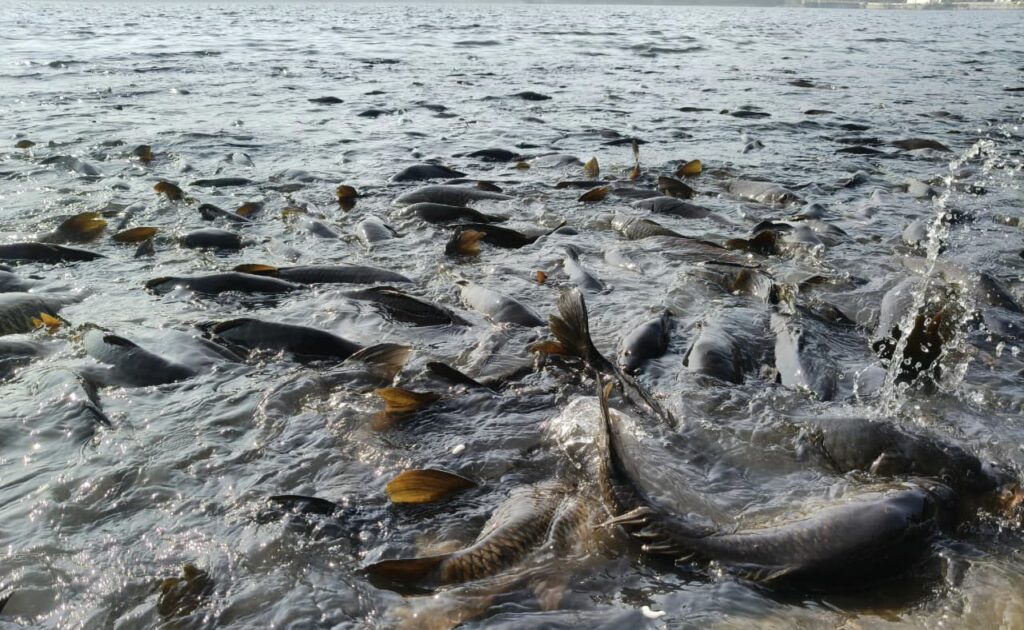
For families, the lake is the site of the Mundan ceremony—the first ritual tonsuring of a male child. It is believed that by offering the child’s hair at the feet of Sheshnag and dipping them in the holy waters, the soul is cleansed of the remnants of past lives. The lake’s sanctity is so absolute that fishing is strictly prohibited for religious reasons; the diverse fish and ancient tortoises are regarded as the “progeny of the Naga,” protected by divine decree.
A Modern Sanctuary of Nature and Faith
Today, the Sheshnag Temple and Mansar Lake form a dual sanctuary of faith and ecology.
As a designated Ramsar wetland site, the area is a vital habitat for migratory birds like cranes and ducks that fly in from as far as Siberia. The surrounding Surinsar-Mansar Wildlife Sanctuary provides a lush backdrop of Pinus rouxburgii and Acacia, where Neelgai and Spotted Deer roam, often seen near the temple’s edge at dawn.
For the modern traveler, a visit to the Sheshnag Temple is a journey through time.
As the sun sets over the Shivaliks, reflecting off the tranquil waters that once served as an exit from the underworld, one can almost hear the whistle of Babru Vahan’s arrow. It is a place where history is not found in books, but in the ripple of the water, the clink of the temple bells, and the enduring shadow of the six-headed serpent king.
About Babru Vahan :-
In the rich tapestry of the Mahabharata, Babruvahana stands out as a tragic and powerful figure whose story explores the complex themes of destiny, filial duty, and divine intervention.
Parentage and Early Life :-Babruvahana was born from the union of Arjuna, the legendary Pandava archer, and Chitrangada, the warrior princess of Manipur.
During Arjuna’s twelve-year exile, he visited Manipur and fell in love with Chitrangada. However, her father, King Chitravahana, stipulated that any son born to her must remain in Manipur to succeed the throne, as they followed a matrilineal system of succession. Consequently, Arjuna left Manipur before his son was born, and Babruvahana was raised by his mother and grandfather, eventually becoming a formidable king and a peerless archer.
The Conflict: The Ashvamedha Yagna :-The most defining moment of Babruvahana’s life occurred years after the Kurukshetra War. Following the victory of the Pandavas, Yudhisthira performed the Ashvamedha Yagna (Horse Sacrifice) to establish imperial sovereignty.
Arjuna was tasked with guarding the sacrificial horse as it roamed through various kingdoms.When the horse entered the territory of Manipur, Babruvahana, following the code of Kshatriya (warrior) conduct, captured it.
Initially, he approached his father with humility, but Arjuna—unaware of the boy’s identity and testing his warrior spirit—rebuked him for not showing the “fire of a kshatriya.” Provoked and encouraged by his stepmother, the Naga princess Uloopi, Babruvahana engaged Arjuna in a fierce battle.The Death and Revival of ArjunaThe battle was intense. Babruvahana proved to be equal, if not superior, to his father in archery. In a climactic moment, he fired a divine arrow that decapitated Arjuna.
Overcome with grief upon realizing he had killed his own father, Babruvahana decided to end his own life.However, Uloopi intervened. She revealed that Arjuna’s death was a karmic necessity to cleanse him of the sin of killing Bhishma through unfair means (using Shikhandi as a shield). She produced the Sanjivani Mani (a life-giving Naga gem). By placing the gem on Arjuna’s chest, the Pandava hero was miraculously revived, and the father and son were finally reconciled.
Cultural Significance and Legend :- While the primary Mahabharata places this event in Manipur (East India), local traditions in the Jammu region have long identified their landscape with this epic.
Surinsar and Mansar: Local legends suggest Babruvahana shot an arrow into the ground to create a tunnel to the netherworld (Patal Lok) to fetch the gem from Sheshnag. The entry and exit points of this “tunnel” are said to be the modern-day Surinsar and Mansar Lakes. *
Symbolism: Babruvahana symbolizes the “unrecognized hero”—a son who must prove his worth through conflict, ultimately leading to spiritual and familial healing.